
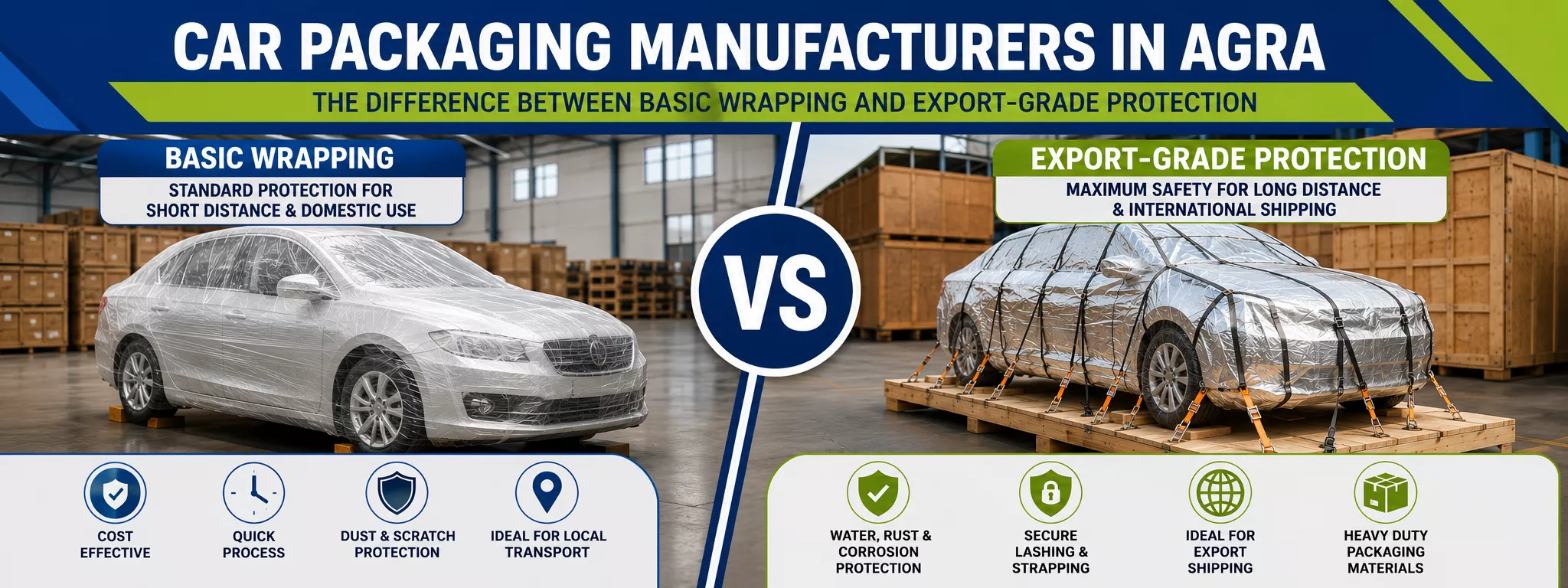
Car Packaging Manufacturer in Agra - The Difference Between Basic Wrapping and Export-Grade Protection
A car that travels 300 km by road and a car that spends three weeks inside a shipping container face completely different risks. Yet a surprising number of buyers ask for "wrapping" when what they actually need is full export-grade protection — and only find out the difference after a vehicle arrives with rust spots or a cracked bumper clip. At Vijay Packing Company, getting this call right is really what separates a competent packer from one that's just selling plastic sheets by the roll.
What "Basic Wrapping" and "Export-Grade Protection" Mean in Car Packing
Basic wrapping is surface-level. It covers the car body in stretch film or a fitted cover to stop dust, light scratches, and bird droppings during a short haul. It's cheap, fast to apply, and fine for domestic transport where the vehicle stays on land and reaches its destination within a few days.
Export-grade protection is a system, not a single layer. It combines body wrapping with corrosion inhibitors, sealed joints, secure anchoring, and often a wooden crate or skid — built to withstand humidity, salt air, vibration, and weeks of handling across ports and customs checkpoints. It costs more because it's solving a longer, harder problem.
The confusion usually starts when a client assumes "packing" is one service with one price. In reality, the packing method has to match the journey — and this is the exact judgment call a car packaging manufacturer in Agra makes on every single order, long before a roll of film or a sheet of plywood comes out.
How to Decide Which Car Packing Protection Level You Need
Before choosing between the two, run through these questions:
How far is the vehicle traveling, and by what mode?
Road-only trips within a few states rarely need export-grade materials. Sea or air freight almost always does.
What's the climate exposure along the route?
Coastal ports and long transit times mean higher humidity and corrosion risk.
How long will the vehicle sit before delivery?
A car parked at a port for two weeks needs car transport packaging solutions built for that kind of dwell time, not the same protection as one delivered same-day.
What's the vehicle's value and finish?
Premium paint, EV battery housings, and luxury trims are more sensitive to scratching and moisture than standard models.
Does the destination country have import documentation requirements?
Some markets require specific markings or treated wood packaging by law.
Answering these five questions upfront saves both money and disappointment — paying for export-grade materials on a short domestic run is wasted spend, and using basic wrapping for an ocean shipment is a real gamble.Answering these five questions upfront saves both money and disappointment — paying for export-grade materials on a short domestic run is wasted spend, and using basic wrapping for an ocean shipment is a real gamble. At Vijay Packing Company, this is usually the first conversation we have with a client before quoting any job.
How the Car Packing Process Actually Works
Whichever protection level applies, the workflow follows a similar sequence on-site:
- Vehicle inspection — checking existing scratches, dents, or fluid leaks and photographing the condition before packing begins. This protects both the client and the packer if a dispute arises later.
- Surface preparation — cleaning the body and mirrors so wrap material doesn't trap dust or moisture against the paint.
- Wrapping or crating applying stretch film and covers for basic jobs, or building a full crate with foam bracing and VCI paper for export jobs.
- Anchoring and securing — strapping the vehicle to a base platform or pallet so it can't shift during loading, transit, or rough handling.
- Marking and documentation — adding handling instructions, fragile/orientation markings, and any compliance labels the destination market requires.
- Final check before dispatch — confirming straps are tight, seals are intact, and nothing was missed before the vehicle leaves the yard.
Skipping the inspection step is one of the more common shortcuts we see elsewhere in the industry — and it's usually the first thing that causes a dispute over "pre-existing damage." It's also one of the easiest ways to tell reliable car packing services in Agra apart from vendors just going through the motions.
Basic Wrapping vs Export-Grade Car Packing Protection: A Side-by-Side Look
| Factor | Basic Wrapping | Export-Grade Protection |
|---|---|---|
| Typical Use Case | Domestic Road Transport, Short Distance | Sea/Air Export, Long-Distance or Overseas Shipment |
| Materials Used | Stretch Film, Fitted Covers | VCI Paper, Foam Bracing, Wooden Crates/Skids, Sealed Wraps |
| Corrosion Protection | Minimal to None | Built-In, Especially for Metal Parts and Undercarriage |
| Handling Duration Tolerance | Days | Weeks |
| Documentation/Markings | Rarely Required | Often Mandatory for Customs and Destination Compliance |
| Relative cost | Lower | Higher, but proportional to risk avoided |
Common Car Packing Mistakes to Watch For
Assuming all car packers offer the same materials
Ask specifically what's used — cheap stretch wrap and export-grade VCI film are priced very differently for a reason.
Skipping the pre-packing car inspection
Without a documented condition report, it's your word against the packer's if damage shows up later.
Ignoring the destination country's import rules
Some countries require heat-treated or certified wood packaging material for customs clearance — using the wrong crate material can delay the entire shipment.
Choosing based on price alone
The cheapest quote sometimes means thinner film, no bracing, or no anchoring — savings that disappear the moment the vehicle needs bodywork after arrival.
Not asking about post-packing support
A packer who disappears after wrapping the vehicle can't help if a strap loosens during loading.
Car Packing Standards and Compliance Worth Knowing
For international shipments, wooden crates and skids typically need to meet ISPM 15, the international standard for wood packaging material used in export, which requires treatment to prevent the spread of pests through untreated wood. You can review the official requirements through the International Plant Protection Convention's ISPM 15 standard page. This isn't optional paperwork — customs authorities in many countries will hold or reject shipments packed with non-compliant wood.
Beyond that, there's no single universal certification for "car packaging" the way there is for, say, food-grade packaging. What matters more in practice is whether the packer documents the vehicle's condition, uses appropriate corrosion protection for the transit duration, and follows the destination market's specific import requirements.
Why This Car Packing Distinction Matters to Vijay Packing Company
Handling both short domestic dispatches and longer export consignments day to day means seeing, firsthand, what actually goes wrong when the wrong protection level gets applied. A dealership sending a car two cities over doesn't need the same treatment as an exporter shipping units through a coastal port with a three-week transit window — and treating both the same either overcharges one client or under-protects the other.
Our approach starts with the same questions outlined above: distance, climate, dwell time, vehicle value, and destination requirements. From there, we build custom packaging solutions rather than defaulting to one method for every job. For vehicles or components that need extra corrosion protection specifically, our vacuum packaging service is often paired alongside standard vehicle wrapping to seal out moisture entirely.
The Practical Car Packing Takeaway
Basic wrapping and export-grade protection aren't interchangeable, and the right choice depends on how far the vehicle is going, how long it will sit in transit, and what the destination market requires. Getting this wrong either costs more than necessary or risks the vehicle itself.
If you're planning a shipment and aren't sure which level applies to your situation, it's worth a quick conversation before committing to a quote. You can see our full range of services on our main car packaging page for Agra, and if you're coordinating shipments from other regions, we also support clients through our Punjab operations.
As a car packaging manufacturer in India operating across multiple states, matching the packing method to the actual journey — not just the vehicle — is what keeps cars arriving the way they left.
FAQs
Q1. What is the main difference between basic wrapping and export-grade car packing
Basic wrapping covers the car with stretch film or a fitted cover to guard against dust and light scratches on short trips. Export-grade car packing adds corrosion inhibitors, sealed joints, secure anchoring, and often a wooden crate to survive long transit through humidity, salt air, and repeated handling.
Q2. When should I choose export-grade car packing instead of basic wrapping?
Choose export-grade packing when the car is going by sea or air, or will sit in transit or storage for more than a few days. Basic wrapping is enough for short road transport that reaches its destination within a day or two.
Q3. What materials are used in export-grade car packing that basic wrapping doesn't inc
Export-grade car packing typically adds VCI (vapor corrosion inhibitor) paper, foam bracing, a base platform or pallet, and a wooden crate or skid. Basic wrapping relies mainly on stretch film and fitted covers, with no built-in corrosion protection.
Q4. Is export-grade car packing only needed for international shipments, or also for domestic transport?
It's mainly needed for international shipments, but some domestic routes benefit from it too — particularly long-distance moves through humid regions or trips where the car will sit at a yard or warehouse for an extended period before delivery.
Q5. Does export-grade car packing cost more than basic wrapping, and is the extra cost worth it?
Yes, it costs more because of the added materials and labor. That said, the extra cost is usually small compared to what it would cost to repair rust or transit damage on a car that was under-protected for a long or overseas journey.

