
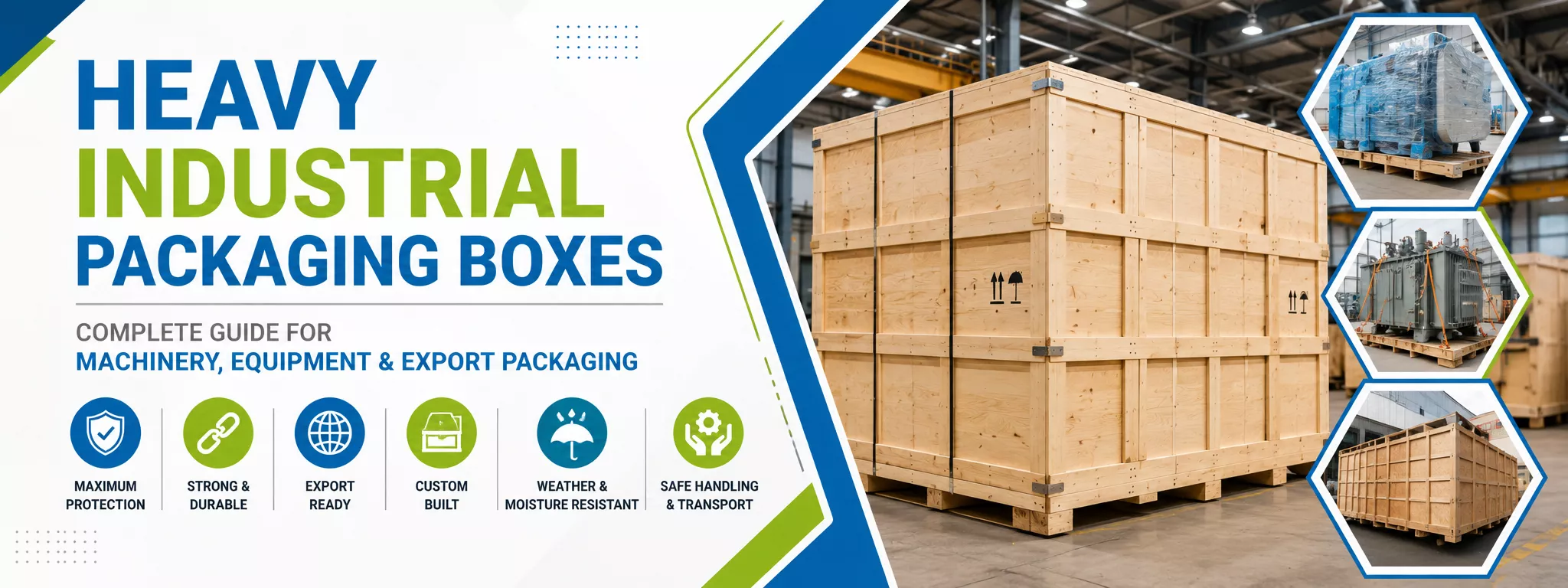
Heavy Industrial Packaging Boxes: Complete Guide for Machinery, Equipment & Export Packaging
What Are Heavy Industrial Packaging Boxes?
Heavy industrial packaging boxes are structural wooden or plywood enclosures built to protect machinery, equipment, and heavy components during handling, storage, and transport. Unlike standard cartons, these boxes are engineered to carry significant load weight, resist shock during loading and unloading, and withstand rough handling at ports, warehouses, and job sites.
They are used wherever equipment needs to travel by road, sea, or air without damage to internal parts, alignment, or finish. A manufacturer shipping a CNC machine to a port, or an exporter sending a generator overseas, relies on this type of packaging to keep the product intact from the factory floor to the final destination.
Why Heavy Industrial Packaging Matters?
Machinery and industrial equipment often contain precision components, sensitive electronics, or moving parts that cannot tolerate vibration, moisture, or impact. A packaging failure at any stage of transport can lead to:
- Misalignment of internal parts
- Corrosion from moisture exposure
- Cracked housings or bent frames from impact
- Delays and disputes over damaged goods at the port
Good packaging design accounts for the weight of the item, the mode of transport, the handling equipment available at both ends, and the climate conditions the shipment will pass through. This is why packaging decisions are usually made alongside logistics planning, not after it.
Types of Heavy Industrial Packaging Boxes
Wooden Crates
Wooden cratesare open or semi-open frame structures built around a load, usually with a base, sides, and top made from timber battens. They suit irregularly shaped machinery where full enclosure is not necessary, such as engine blocks or structural steel parts.
Plywood Boxes
Plywood boxes use plywood sheets over a wooden frame to create a fully enclosed box. They offer better protection against dust, light rain, and tampering compared to open crates, making them suitable for electronic panels, control units, and finished equipment.
Wooden Pallets
Wooden pallets are flat, load-bearing platforms used as a base for stacking or securing goods, often combined with crates or boxes for forklift and crane handling. Pallets simplify loading into containers and reduce direct contact between goods and the ground.
Heavy-Duty Skid Boxes
Skid-mounted boxes are built on a reinforced base with runners, allowing the box to be dragged or lifted by forklift without a separate pallet. These are common for heavy machinery packing where the equipment itself sits directly inside a skid frame.
Applications
Heavy industrial packaging boxes are used across several sectors:
- Manufacturing plants shipping finished machinery to buyers
- Exporters sending equipment overseas by sea freight or air freight
- Engineering companies relocating machines between plants or sites
- OEMs packing components for domestic and international dealers
- Logistics companies managing multi-modal transport of heavy cargo
Each application has different weight, size, and climate considerations, which is why box design is rarely one-size-fits-all.
Materials Used in Industrial Packaging
Timber Grades
Timber used in industrial crates is graded by strength, moisture content, and knot density. Higher-grade timber resists warping and holds fasteners more securely under load.
Pine Wood
Pine wood is a common softwood choice for crates and pallets because it is lightweight, easy to work with, and cost-effective for medium-weight loads. It is less suited to very high load-bearing applications compared to hardwood.
Hardwood
Hardwood offers greater density and load capacity, making it a better choice for heavier machinery or repeated-use pallets. It is typically more expensive and heavier than pine.
Plywood
Plywood is manufactured by bonding thin wood veneers under pressure, which gives it more uniform strength and resistance to splitting than solid timber sheets. It is commonly used for the outer panels of enclosed boxes.
Manufacturing Process
The process typically begins with load assessment, where the weight, dimensions, and center of gravity of the equipment are measured. This determines the timber grade, panel thickness, and internal bracing needed.
Next, the frame is built to match the load-bearing points of the equipment rather than just its outer shape. Internal cleats, bracing, and cushioning are added to prevent movement inside the box during transit.
Finally, the box is sealed, strapped, and labeled with handling instructions such as center-of-gravity markings, weight limits, and orientation arrows. For export shipments, ISPM-15 compliance markings are applied at this stage.
ISPM-15 and Heat Treatment
ISPM-15 is an International Plant Protection Convention (IPPC) standard that governs wood packaging material used in international trade, aimed at preventing the spread of pests through untreated wood. Most countries require compliance for any wooden crate, pallet, or box crossing a border.
Heat treatment is the most common method of meeting ISPM-15 requirements. It involves heating the wood core to a minimum temperature for a set duration to eliminate pests and larvae inside the timber. Treated wood is stamped with an IPPC mark showing the treatment code and country of origin.
Skipping ISPM-15 compliance can result in shipments being held, fumigated, or rejected at customs, which adds cost and delay to an export order.
Vacuum Packaging and Moisture Protection
Vacuum packaging removes air from around sensitive equipment before it is sealed inside a barrier film, reducing exposure to humidity and oxidation during long transit periods, particularly by sea freight.
This is often combined with:
- VCI film (Vapor Corrosion Inhibitor film), which releases a protective vapor that coats metal surfaces and slows down corrosion
- Desiccants, which absorb residual moisture trapped inside the sealed packaging
- Steel strapping, used to secure the load to the pallet or crate base and prevent shifting during transport
For machinery with exposed metal surfaces, moisture protection is often as important as the structural strength of the box itself.
Quality Testing
Before dispatch, packaged loads are typically checked for:
- Load distribution across the base, to confirm weight is evenly spread and won't stress one section of the crate
- Weight capacity of the timber and fasteners against the actual load
- Shock protection through internal bracing and cushioning materials
- Strapping tension to confirm the load cannot shift during handling
Some shipments also undergo a trial lift with forklift or crane handling equipment to confirm the box behaves as expected under real handling conditions before it leaves the facility.
Advantages of Heavy Industrial Packaging
- Reduces the risk of transit damage to expensive machinery
- Supports safe forklift and crane handling at multiple transit points
- Meets international shipping and customs requirements when properly treated
- Protects against moisture, dust, and minor impact during storage
Limitations
- Custom-built boxes take more time to design and produce than standard cartons
- Heavier crates and pallets add to overall shipping weight and freight cost
- Poorly designed bracing can still allow movement even inside a strong box
- Reused pallets and crates need inspection before every shipment for hidden damage
Common Mistakes in Industrial Packaging
- Using a box or crate not designed for the actual weight of the machine
- Ignoring the center of gravity when placing the load inside the box
- Skipping ISPM-15 heat treatment for export shipments
- Under-strapping loads, allowing shifting during sea freight
- Choosing pine wood for loads that require hardwood-level strength
How to Choose the Right Packaging Solution?
Selecting the right box depends on several factors working together, not any single one in isolation:
- Weight and dimensions of the equipment
- Mode of transport — sea freight, air freight, or road transport each have different handling stresses
- Climate exposure during transit and storage, including humidity and temperature swings
- Handling equipment available at loading and unloading points, such as forklifts or cranes
- Export documentation requirements of the destination country, including ISPM-15 compliance
If you need custom industrial packaging for export machinery, Vijay Packing Company can assess your requirements and recommend a suitable packaging solution based on the equipment's weight, route, and handling conditions.
Where to Find a Heavy Industrial Packaging Box Manufacturer?
Industrial clusters across North India each have their own concentration of manufacturing units, and packaging needs often depend on what is produced locally.
A heavy industrial packaging box manufacturer in Gurgaon typically serves automotive component and engineering units, where equipment is packed for both domestic dispatch and export. In Faridabad, a heavy industrial packaging box manufacturer usually works with machine tool and casting units that need crates built for heavier, denser loads.
Noida and Ghaziabad host a mix of electronics, engineering, and consumer goods manufacturers, so a heavy industrial packaging box manufacturer in these areas often handles a wider variety of box sizes and enclosure types, from plywood boxes for control panels to crates for larger assemblies. Sonipat's industrial belt includes machinery and equipment producers, where a heavy industrial packaging box manufacturer in Sonipat is generally involved in packing for both intercity transport and export.
Further out, a heavy industrial packaging box manufacturer in Punjab often supports agricultural machinery and light engineering exports, while a heavy industrial packaging box manufacturer in Haridwar typically works with pharmaceutical and electronics manufacturing units that need moisture-sensitive packaging such as vacuum sealing and VCI film.
Regardless of location, the packaging principles remain the same: correct timber grade, proper load distribution, and compliance with ISPM-15 where the shipment is crossing an international border.
Cost Factors
Packaging cost is influenced by timber grade, box size, internal bracing complexity, and whether vacuum packaging or VCI film is required. Export shipments requiring ISPM-15 heat treatment typically cost more than domestic packaging due to the treatment process and certification.
Reusable pallets and crates can lower long-term cost for companies with recurring shipments, provided they are inspected and maintained between uses.
Maintenance and Storage Tips
- Store wooden crates and pallets off the ground to avoid moisture absorption
- Inspect timber for cracks, splits, or pest damage before reuse
- Keep desiccants and VCI film sealed until packaging day to preserve effectiveness
- Re-tighten steel strapping if a crate is moved or repositioned before dispatch
Latest Industry Trends
More exporters are combining vacuum packaging with VCI film for corrosion-sensitive machinery, rather than relying on wood protection alone. There is also growing attention to accurate export documentation and ISPM-15 marking, as customs checks on wood packaging have become stricter across several destination countries. Engineering companies relocating machines between plants are increasingly requesting skid-mounted boxes for faster forklift handling on both ends of the move.
FAQs
Q1. What is the difference between a wooden crate and a plywood box?
A wooden crate is typically an open or semi-open frame structure, while a plywood box is fully enclosed with plywood panels, offering more protection from dust and light moisture.
Q2. Is ISPM-15 treatment mandatory for all wood packaging?
Most countries require ISPM-15 heat treatment for any wooden packaging material used in international shipments, though requirements can vary slightly by destination.
Q3. How is the weight capacity of a packaging box determined?
It is based on the timber grade, panel thickness, internal bracing design, and the load distribution across the base.
Q4. Can the same box be used for both sea freight and air freight?
It depends on the design. Air freight often needs lighter packaging due to weight-based freight costs, while sea freight packaging is usually built for longer transit and more handling stages.
Q5. What is VCI film used for?
VCI film releases a vapor that coats metal surfaces to slow down corrosion during storage or transit, especially in humid conditions.
Q6. Do wooden pallets need to be treated separately from crates?
Yes, if a pallet is used for export, it needs its own ISPM-15 treatment and marking, even if it's used along with a treated crate.
Q7. How do I know if my machinery needs vacuum packaging?
Equipment with exposed metal surfaces, electronics, or components sensitive to humidity generally benefits from vacuum packaging combined with desiccants.
Q8. What causes most transit damage to industrial equipment?
Incorrect load distribution, insufficient bracing, and under-strapping are common causes, along with using packaging not rated for the actual weight of the item.
Q9. Can heavy industrial packaging boxes be reused?
Yes, provided they are inspected for structural damage, pest infestation, and moisture issues before each reuse.
Q10. What export documentation is linked to packaging?
ISPM-15 compliance certificates and treatment markings are often required alongside standard shipping documents like the packing list and bill of lading.
Conclusion
Heavy industrial packaging boxes exist to solve a specific problem: keeping machinery and equipment intact through the stress of handling, storage, and long-distance transport. The right choice depends on load weight, transport mode, climate exposure, and destination country requirements, not on picking the strongest-looking box available.
Manufacturers, exporters, and logistics teams that plan packaging alongside their shipping route tend to avoid the delays and damage claims that come from mismatched packaging. If you're evaluating packaging options for an upcoming shipment, Vijay Packing Company can review the equipment specifications and route details to suggest a suitable box design.

