
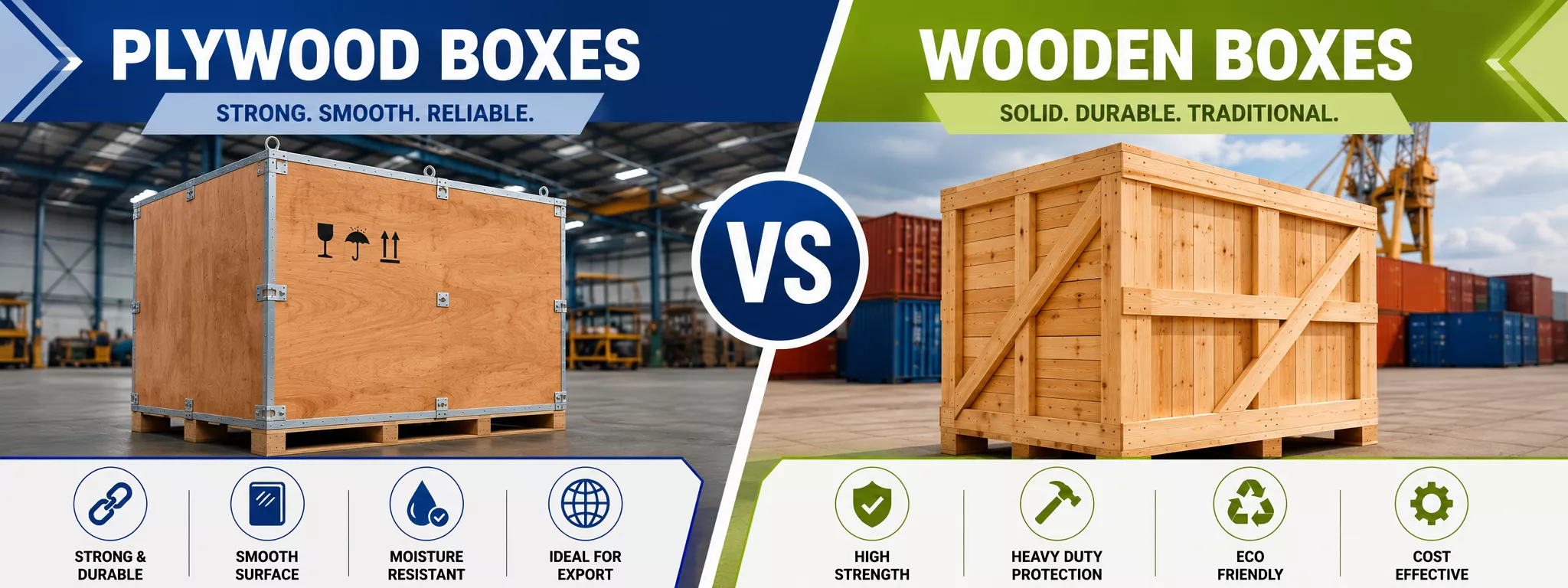
Plywood Boxes vs Wooden Boxes: Which Packaging Solution Is Better for Industrial and Export Goods?
A plywood box is a packaging container made from layers of thin wood veneer bonded together under pressure, while a wooden box is built from solid timber planks joined at the edges. Both protect goods during transport, but they differ in weight, strength, moisture resistance, and cost. Manufacturers, exporters, and logistics teams need to know these differences before choosing a packaging method, because the wrong choice can lead to damaged goods, rejected export shipments, or unnecessary freight costs.
This guide compares plywood boxes and wooden boxes across every factor that matters for industrial and export packaging, so you can select the right option for your product, budget, and destination.
What Is a Plywood Box?
A plywood box is constructed from plywood sheets , which are made by gluing multiple thin layers of wood veneer with the grain direction alternating in each layer. This cross-layering gives plywood consistent strength in all directions and reduces the chances of warping or splitting.
Plywood boxes are commonly used for packing machinery parts, electronic equipment, automotive components, and general export cargo where a balance of strength and weight is needed.
What Is a Wooden Box?
A wooden box is made from solid sawn timber usually pine or similar softwood, assembled into panels and joined with nails, screws, or battens. Unlike plywood, wooden boxes use single pieces of wood rather than laminated layers.
Wooden boxes are typically chosen for heavier loads, irregular-shaped machinery, or situations where extra rigidity is required, such as packing industrial equipment for sea freight.
Why Packaging Material Choice Matters?
The material you choose affects four things directly: how well the product survives transit, how much the shipment weighs, how much it costs to produce and ship, and whether it meets export regulations. Getting this decision wrong is expensive to fix after the goods are already packed or shipped.
For example, a machine packed in an undersized wooden crate may experience movement during transit, leading to internal damage. A plywood box that is too thin for a heavy load may crack under stacking pressure in a container.
Types of Plywood and Wooden Boxes
Plywood Box Types
- Standard plywood boxes - general-purpose boxes for light to medium industrial goods
- Reinforced plywood boxes - built with wooden battens or metal corners for added strength
- Vacuum-sealed plywood boxes - used with a moisture barrier film for sensitive electronics or machinery
- Collapsible plywood boxes - designed to fold flat for return shipments or storage savings
Wooden Box Types
- Solid wood crates - open or closed frame structures for heavy machinery
- Skeleton crates - open-frame wooden structures for large or irregular items where full enclosure isn't needed
- Sheathed wooden crates - solid wood frame with plywood or timber panel cladding
- Heavy-duty wooden pallbox - combines a pallet base with wooden side panels for palletized loads
Applications by Industry
Manufacturers exporting machine tools, engineering components, and industrial spares generally use wooden crates or reinforced plywood boxes, depending on weight. Electronics and precision instrument makers often prefer plywood boxes with vacuum packaging and desiccants to control moisture. Automotive parts suppliers commonly use plywood boxes for their combination of strength and lower shipping weight.
Logistics companies handling mixed cargo tend to keep both plywood and wooden box options available, matching the packaging to each client's product type and destination country requirements.
Materials Used in Manufacturing
Plywood Composition
Plywood used for industrial boxes is typically made from hardwood or a mix of hardwood and softwood veneers, bonded with water-resistant adhesive. The number of layers, called plies, affects the thickness and load-bearing capacity of the final sheet.
Timber Grades for Wooden Boxes
Wooden boxes are usually made from pine wood or other softwood timber. Timber grade refers to the quality classification based on knots, moisture content, and structural soundness. Higher-grade timber has fewer defects and performs better under load, though it costs more than lower-grade wood.
Manufacturing Process
How Plywood Boxes Are Made
The process starts with cutting plywood sheets to size based on the product dimensions. Panels are then assembled using nails, screws, or wood glue, with internal bracing added for heavier items. Corners may be reinforced with wooden battens or metal angles. The finished box is checked for dimensional accuracy before the product is loaded.
How Wooden Boxes Are Made
Solid timber is cut into planks and assembled into panel frames. For crates, a base skid is built first to allow forklift handling, followed by side panels, and finally a top panel once the goods are placed inside. Battens are added across panels to prevent warping and increase rigidity for heavy loads.
Industry Standards and Export Compliance
ISPM-15 Requirement
ISPM-15 is an international phytosanitary standard set by the International Plant Protection Convention (IPPC) that applies to wood packaging material used in international trade. It requires that solid wood packaging, including pallets, crates, and wooden boxes, be either heat treated or fumigated to eliminate pests, and then stamped with an approved mark.
This standard applies to solid wood packaging. Plywood, because it is a manufactured wood product rather than raw solid wood, is generally exempt from ISPM-15 treatment in most countries, though exporters should confirm requirements for their specific destination country.
Heat Treatment
Heat treatment involves raising the core temperature of wood packaging material to at least 56°C for a minimum of 30 minutes, which kills insects and larvae that could otherwise spread across borders. Heat-treated wood is marked with the IPPC stamp, along with a code indicating the treatment method and country of origin.
Quality Testing Before Dispatch
Before goods are dispatched, packaging should be checked for panel strength under load, corner joint stability, moisture content of the wood, and overall box dimensions against the shipping container size. For export shipments, the ISPM-15 stamp on wooden boxes should be verified, since customs authorities in many countries reject non-compliant wood packaging at the port.
Strength Comparison
Wooden boxes generally offer higher rigidity for very heavy or irregularly shaped loads because solid timber resists point-load pressure well. Plywood boxes offer strong, even resistance to bending and cracking because of the cross-layered veneer construction, which makes them suitable for moderate to heavy loads where uniform strength matters more than sheer mass.
For extremely heavy machinery, wooden crates with internal bracing are usually preferred. For general industrial and export goods up to moderate weight, plywood boxes perform reliably while keeping the package lighter.
Weight Comparison
Plywood boxes are lighter than solid wooden boxes of similar strength, because the layered veneer construction achieves structural performance with less material. This weight difference directly affects freight cost, particularly for air freight, where charges are based on volumetric or actual weight, whichever is higher.
Moisture Resistance
Plywood, when bonded with water-resistant adhesive, tends to resist moisture absorption and warping better than solid wood, since the cross-layered structure limits expansion in any single direction. Solid wooden boxes can absorb moisture unevenly across the grain, leading to warping or swelling if exposed to humidity for extended periods, particularly during sea freight.
Adding a vacuum packaging layer with VCI film (vapor corrosion inhibitor film) and desiccants inside either box type further protects sensitive goods like electronics and machined metal parts from moisture and corrosion during transit.
Cost Comparison
Plywood boxes are generally less expensive to produce for light to medium loads, since less raw material is needed and manufacturing is faster. Wooden boxes can cost more for equivalent strength, especially when heavy-grade timber and additional bracing are required for large machinery.
However, for very heavy or oversized cargo, a wooden crate may end up more cost-effective overall, because achieving equivalent strength in plywood would require significantly thicker sheets and additional reinforcement.
Advantages and Limitations
Plywood Box Advantages
- Lighter weight, reducing freight cost
- Consistent strength in all directions
- Better resistance to warping
- Faster to manufacture
- Often exempt from ISPM-15 treatment
Plywood Box Limitations
- Less suitable for very heavy, concentrated loads
- Lower resistance to sharp impact compared to solid timber in some cases
Wooden Box Advantages
- High load-bearing capacity for heavy machinery
- Better resistance to point impact
- Suitable for irregular or oversized items
Wooden Box Limitations
- Heavier, increasing freight cost
- Requires ISPM-15 heat treatment for export
- More prone to warping if timber grade is poor
Common Mistakes in Industrial Packaging
Many businesses select box thickness based on product weight alone, without considering how the load will be distributed inside the box or how it will be handled during forklift and crane handling. Others skip a check of container loading dimensions, resulting in boxes that don't fit efficiently, wasting container space and increasing shipping cost.
A frequent export mistake is shipping solid wood packaging without a valid ISPM-15 stamp, which can lead to shipments being held or rejected at customs. Another common issue is failing to add adequate shock protection or moisture protection for sensitive machinery, leading to damage that could have been avoided with vacuum packaging or additional internal bracing.
How to Choose the Right Packaging Solution?
Start by identifying the weight and shape of the product. Heavy, irregular machinery generally suits a wooden crate with internal bracing. Lighter to moderate loads, especially those needing moisture control, are often better suited to a plywood box.
Next, check the destination country's import regulations, particularly ISPM-15 requirements if solid wood packaging is being used. Then consider the mode of transport: air freight favors lighter plywood packaging to control cost, while sea freight in containers can accommodate heavier wooden crates when the product demands it.
Finally, factor in load distribution and weight capacity of the base, since an undersized base skid or panel can fail under stacking pressure inside a container.
Buying Checklist
- Confirm product weight, dimensions, and fragility
- Check destination country packaging regulations
- Verify ISPM-15 compliance for solid wood packaging
- Decide between plywood box or wooden crate based on load type
- Confirm internal protection needs: VCI film, desiccants, shock absorbers
- Check base strength for forklift and crane handling
- Match box dimensions to container loading plan
- Request quality testing confirmation before dispatch
Cost Factors to Consider
Beyond raw material, cost is influenced by box design complexity, the amount of internal bracing required, whether vacuum packaging or VCI film is added, and the volume of boxes ordered. Bulk orders typically reduce per-unit cost, while custom sizes for one-off machinery shipments cost more due to manual fabrication.
Maintenance and Storage Tips
Both plywood and wooden boxes should be stored in a dry, covered area before use to prevent moisture absorption that weakens the material ahead of packing. Stacking limits should be respected during storage to avoid panel deformation. If boxes are being reused, they should be inspected for cracks, loose joints, or pest damage before being packed again.
Latest Industry Trends
More exporters are shifting toward plywood boxes for mid-weight cargo to reduce freight costs, particularly as freight pricing has become more sensitive to volumetric weight. There is also growing use of collapsible plywood boxes that reduce storage space and return shipping costs for reusable packaging programs.
Vacuum packaging combined with VCI film is increasingly standard for electronics and precision machinery exports, since it reduces the risk of corrosion-related claims during long transit times, particularly for sea freight to humid regions.
If you're evaluating packaging for an upcoming export shipment, Vijay Packing Company can review your product specifications and recommend whether a plywood box or wooden crate fits your handling, freight, and compliance needs.
Frequently Asked Questions
Q1. What is the difference between a plywood box and a wooden box?
A plywood box is made from layered wood veneer bonded together, while a wooden box is built from solid timber planks. Plywood boxes are lighter and resist warping better, while wooden boxes offer higher strength for very heavy loads.
Q2. Do plywood boxes need ISPM-15 treatment for export?
Plywood is generally exempt from ISPM-15 treatment since it is a manufactured wood product, not raw solid wood. However, requirements can vary by destination country, so it's best to confirm before shipping.
Q3. Which is cheaper, plywood boxes or wooden boxes?
Plywood boxes are usually cheaper for light to medium loads due to lower material use and faster manufacturing. Wooden boxes can become more cost-effective for very heavy or oversized cargo.
Q4. Are plywood boxes strong enough for machinery packing?
Plywood boxes can handle moderate to heavy machinery loads reliably, especially with internal bracing. For extremely heavy or irregular machinery, a wooden crate is often preferred.
Q5. What is heat treatment in wood packaging?
Heat treatment raises the core temperature of wood packaging material to at least 56°C for 30 minutes to eliminate pests, as required under the ISPM-15 standard for solid wood packaging used in international trade.
Q6. Can plywood boxes be used for sea freight?
Yes, plywood boxes are commonly used for sea freight, especially when combined with vacuum packaging and moisture protection for sensitive goods like electronics.
Q7. What is VCI film used for in industrial packaging?
VCI film, or vapor corrosion inhibitor film, is used inside packaging to prevent metal parts from corroding during transit by releasing a protective vapor that coats exposed metal surfaces.
Q8. How do I choose between a plywood box and a wooden crate?
The choice depends on product weight, shape, and destination country regulations. Heavy or irregular machinery generally needs a wooden crate, while lighter to moderate loads suit a plywood box.
Q9. Does plywood box weight affect shipping cost?
, plywood boxes are lighter than equivalent wooden boxes, which reduces freight cost, particularly for air freight where charges are based on weight.
Q10. What is the role of a plywood box supplier in export packaging?
A plywood box supplier designs and manufactures boxes suited to specific product dimensions, weight, and export requirements, helping ensure the packaging meets both handling and compliance needs. Vijay Packing Company works with manufacturers and exporters to assess these requirements before packaging is finalized.
Conclusion
Plywood boxes and wooden boxes each serve different packaging needs. Plywood boxes work well for lighter to moderate loads where weight, cost, and moisture resistance matter, while wooden boxes suit heavy or irregular machinery that needs maximum rigidity. The right choice depends on product weight, destination country compliance, and mode of transport.
For businesses that need help matching packaging to their specific product and export requirements, Vijay Packing Company can assess the shipment details and suggest a suitable plywood box or wooden crate solution.

