
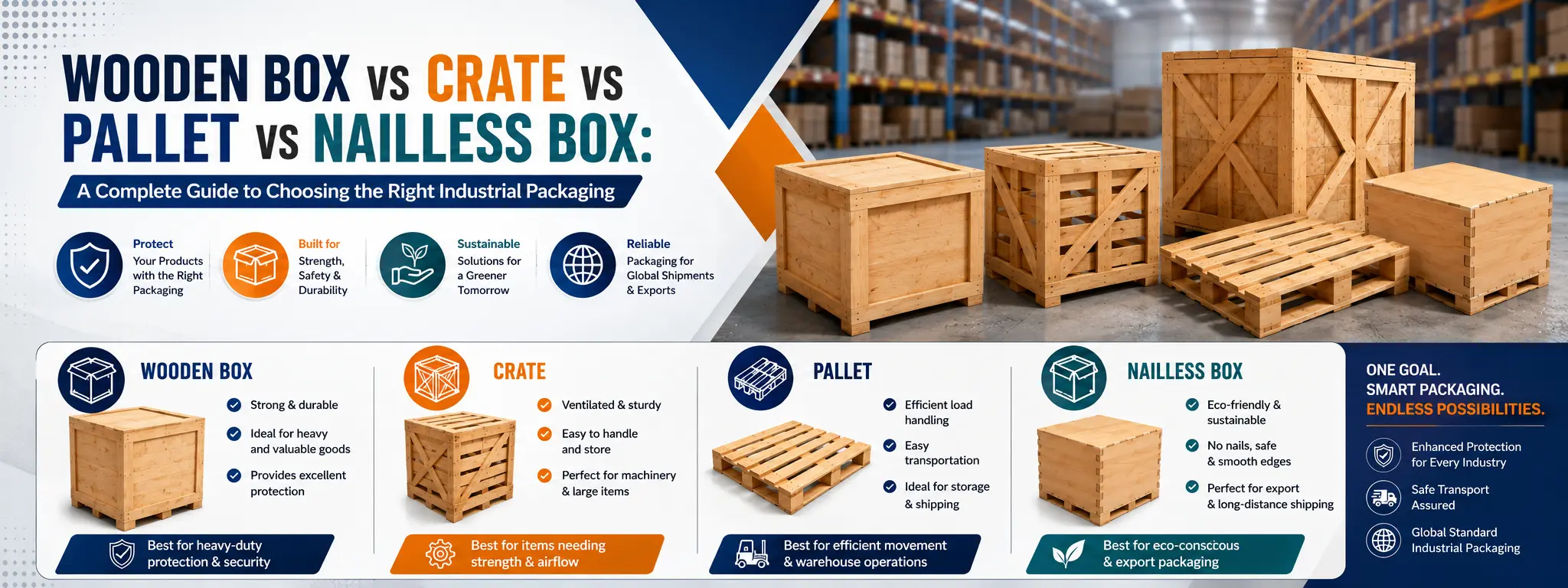
Wooden Box vs Crate vs Pallet vs Nailless Box: A Complete Guide to Choosing the Right Industrial Packaging
If you're shipping machinery, equipment, or export cargo out of Delhi NCR or anywhere in North India, you've probably run into six terms that sound similar but aren't interchangeable: wooden box, wooden crate, wooden pallet, plywood box, nailless box, and vacuumised packaging.
Picking the wrong one isn't just a cost mistake. It can mean a forklift puncturing your load, moisture rusting a machine part mid-transit, or a shipment getting held up at customs because it doesn't meet ISPM15 norms. This guide breaks down what each option actually is, when to use it, and how to combine them for the safest, most cost-effective shipment.
Quick Answer: Which Packaging Do You Need?
- Shipping heavy, high-value, or irregular-shaped machinery? Use a wooden crate.
- Protecting smaller, delicate, or retail-ready goods in an enclosed container? Use a wooden box.
- Moving bulk goods on a forklift or storing stacked inventory in a warehouse? Use a wooden pallet.
- Need something lightweight for fragile or lower-weight export cargo? Use a plywood box.
- Packing and unpacking repeatedly, or need to reuse the container? Use a nailless box.
- Shipping metal parts, electronics, or machinery that rust or corrode with moisture? Add vacuumised packaging inside any of the above.
Read on for the detail behind each of these, plus a side-by-side comparison table you can use to brief your packaging vendor.
What Is a Wooden Box?
A wooden box is a fully enclosed container with solid walls on all six sides. It's built for smaller and mid-weight items that need complete protection from dust, tampering, and light impact - tools, spare parts, electronics, instruments, or retail-ready goods.
Wooden boxes typically use thinner wood than crates, since their job is enclosure and presentation rather than carrying extreme structural loads. Because the walls are solid rather than slatted, they also protect contents from view during transit, which matters for high-value or sensitive cargo.
Best suited for: tools, machine parts, electronics, sensitive instruments, and any goods that need a sealed, tamper-resistant container rather than an open frame.
What Is a Wooden Crate?
A wooden crate is a heavier-duty container, usually built with a reinforced frame and a pallet base so it can be lifted and moved with a forklift. Crates are engineered to carry significantly more weight and stress than boxes, which is why they're the standard choice for industrial and export machinery packing.
Crates can be built as closed crates (fully enclosed plywood or solid panels on all sides) or open/slatted crates (spaced slats for ventilation and visual inspection of contents). The right type depends on whether your cargo needs full weather protection or just structural support.
A properly engineered crate distributes weight through its frame rather than relying on the panel walls, which is what allows it to handle bulky, irregular-shaped, or non-uniform machinery without the walls buckling under load.
Best suited for: industrial machinery, engineering equipment, plant and generator components, and any cargo that's heavy, oddly shaped, or needs to survive rough handling across multiple transit legs, including international shipping.
What Are Wooden Pallets?
A wooden pallet is a flat platform, not an enclosure. It's built from horizontal and vertical wooden beams so it can be picked up and moved by a forklift or pallet jack. Pallets don't protect the sides or top of your cargo - their job is to make handling, stacking, and warehouse storage efficient.
Pallets come in different formats depending on how they'll be lifted and shipped:
- Two-way pallets - can only be lifted from two sides, typically by a pallet jack.
- Four-way pallets - can be lifted from all four sides, giving forklifts more flexibility in tight warehouse aisles.
- Euro pallets - standardised dimensions for pan-European and international freight compatibility.
Pallets are usually the most economical wooden packaging option, since you're paying for a base structure rather than a full container. But if your goods aren't strapped, shrink-wrapped, or boxed on top of the pallet, they're exposed to dust, moisture, and handling damage throughout the journey.
Best suited for: bulk goods, warehouse storage, palletised freight, and shipments where the cargo itself is already boxed, crated, or shrink-wrapped and just needs a base for forklift handling.
What Is a Plywood Box?
A plywood box is a lighter-weight version of a wooden box, built using plywood panels instead of solid timber. Plywood is thinner and less dense than sawn wood, which makes these boxes easier to handle and cheaper to freight, particularly by air.
Because plywood is manufactured in uniform sheets, plywood boxes also tend to have a cleaner, seamless finish compared to boxes built from timber planks. Many plywood boxes are also built as collapsible or foldable units, which brings them close to nailless box territory (see below) - the two categories overlap significantly in the market.
Best suited for: fragile or lightweight goods, export cargo where freight weight directly affects cost, and situations where a full timber crate would be overkill.
What Is a Nailless Box?
A nailless box - also called a collapsible box or interlocking box - is a plywood container assembled using clips, brackets, or an interlocking joint system instead of nails or screws. The panels snap together for assembly and unfold flat for storage or return shipping.
The advantage isn't just speed of assembly. Nailless boxes are collapsible, so an empty box takes up a fraction of the space of a rigid one, which matters if you're shipping goods one way and returning empty containers, or storing packaging inventory on-site. Most nailless boxes are also built to comply with ISPM15 export norms, since they use treated plywood and don't require raw solid wood packing material.
Best suited for: businesses that pack and unpack repeatedly (recurring shipments, rental equipment, reusable packaging programs), and any operation trying to cut storage space and packing time without giving up strength.
What Is Vacuumised Packaging?
Vacuumised packaging isn't a box type - it's a protective layer used inside a wooden box, crate, or pallet-based shipment. It involves sealing the item in a barrier film (typically aluminium-laminated foil) and removing the air to create an airtight, moisture-free environment around the product, often combined with a VCI (Vapour Corrosion Inhibitor) layer for added rust protection.
This matters most for metal components, electrical equipment, precision machinery, and defence-grade cargo, where even small amounts of trapped moisture can cause oxidation or corrosion damage during long transit times or humid storage conditions - damage that isn't visible until the crate is opened at the destination.
Best suited for: machinery with exposed metal parts, electrical and electronic equipment, export shipments with long transit times, and any cargo where corrosion or moisture damage would be costly to reverse.
Wooden Box vs Crate vs Pallet vs Nailless Box vs Plywood Box: Comparison Table
| Packaging Type | Structure | Best For | Weight Capacity | Reusable? | Typical Use Case |
|---|---|---|---|---|---|
| Wooden Box | Fully enclosed, solid walls | Small to mid-weight goods | Low to medium | Sometimes | Tools, parts, instruments |
| Wooden Crate | Reinforced frame + pallet base | Heavy, irregular-shaped cargo | Medium to very high | Sometimes | Industrial machinery, exports |
| Wooden Pallet | Flat base, no sides | Bulk/palletised goods | High (with proper strapping) | Yes | Warehouse storage, forklift handling |
| Plywood Box | Lightweight enclosed panels | Fragile or lightweight goods | Low to medium | Sometimes | Air freight, delicate export cargo |
| Nailless Box | Collapsible, interlocking plywood | Repeat packing/unpacking | Low to high (size-dependent) | Yes, fully collapsible | Reusable shipping, rental equipment |
| Vacuumised Packaging | Barrier film + VCI layer, used inside other packaging | Moisture/corrosion-sensitive cargo | N/A (add-on layer) | No (single use) | Metal parts, electronics, long transit |
How to Choose the Right Packaging for Your Shipment?
Work through these four questions before you brief a vendor:
1. How heavy and how fragile is the cargo? Heavy or irregular machinery needs a crate. Lighter, delicate goods are usually better suited to a box or plywood box.
2. Will the container be reused? If you're packing and unpacking the same cargo type repeatedly, a nailless box saves on storage space and long-term packaging cost compared to a rigid crate.
3. Is the cargo exposed to moisture, humidity, or a long transit time? Any shipment with exposed metal, electronics, or precision parts should have a vacuumised packaging layer inside the primary container, regardless of which box or crate you choose.
4. Are you exporting internationally? Check ISPM15 compliance requirements for the destination country. This affects whether the wood needs heat treatment or fumigation, and whether a nailless or plywood box (treated material) is a simpler compliance route than solid timber.
In most real-world industrial shipments, these packaging types aren't an either/or choice - a heavy machine might travel in a wooden crate, sitting on a pallet base, wrapped in vacuumised barrier film for the exposed metal components. The right packaging plan is usually a combination, matched to what's inside the container, not a single generic box for everything.
Frequently Asked Questions
Q1.Is a wooden crate stronger than a wooden box?
Yes. A crate is built with a reinforced frame that carries the structural load, so it can typically support significantly more weight than a box, whose strength depends largely on its walls and lid.
Q2. Can I use a wooden pallet without a box or crate on top?
You can, but only if the goods are already strapped, shrink-wrapped, or otherwise protected. A bare pallet offers no protection from dust, rain, or side-impact damage during handling.
Q3. Are nailless boxes as strong as regular wooden boxes?
For their weight class, yes. Nailless boxes use an interlocking bracket system that's been engineered specifically for repeated assembly and disassembly without losing structural integrity, and most are rated for loads comparable to standard plywood boxes of the same size.
Q4. Do I need vacuumised packaging for every export shipment?
No. It's needed specifically for cargo that's sensitive to moisture or corrosion - metal parts, electrical equipment, precision machinery. Non-metallic, non-electronic goods usually don't need it.
Q5. What's the difference between a plywood box and a nailless box?
A plywood box refers to the material (plywood panels). A nailless box refers to the assembly method (interlocking joints instead of nails). Many nailless boxes are made of plywood, so the two terms often overlap, but not every plywood box is collapsible or nailless.
Get Packaging Built for Your Shipment, Not a Generic Box
Vijay Packing Company has been manufacturing wooden boxes, crates, pallets, and export-grade packaging out of Delhi NCR since 1972. We build wooden boxes, wooden crates, two-way and four-way pallets, plywood and nailless boxes, and vacuumised/VCI packaging for machinery, electronics, and industrial cargo shipped across India and overseas - including ISPM15-compliant heat treatment and fumigation for export shipments.
If you're not sure which packaging fits your product, talk to our team with your cargo dimensions, weight, and destination, and we'll recommend the right combination - not just sell you a box.

